
In today’s fast-moving supply chain environment, companies are focusing heavily on warehouse efficiency, inventory accuracy, and faster deliveries. Businesses no longer want delays in warehouse operations because even small mistakes can affect customer satisfaction and overall profits. This is one of the main reasons why SAP EWM has become very important for modern businesses.
SAP EWM, also called SAP Extended Warehouse Management, helps companies manage warehouse operations in a more organized and automated way. From goods receiving to inventory tracking and final product dispatch, SAP EWM supports almost every warehouse activity.
Because of this growing demand, many students and professionals are now exploring careers in SAP EWM. One common question people usually ask before entering this field is: “What exactly does an SAP EWM consultant do daily?”
Honestly, the role of an SAP EWM consultant is much more practical than many people imagine. It is not just about system configuration. The job involves understanding warehouse operations, solving business problems, supporting users, and improving overall warehouse efficiency.
For learners planning to enter this field through SAP EWM Training in Bangalore, understanding the daily responsibilities gives a clearer idea about the actual work environment.
Understanding the Role of an SAP EWM Consultant
An SAP EWM consultant mainly works between warehouse business teams and SAP systems. Their responsibility is to ensure warehouse operations run smoothly inside the SAP environment.
Every warehouse follows multiple activities daily such as:
- Receiving goods
- Storing products
- Picking materials
- Packing shipments
- Managing stock transfers
- Dispatching orders
SAP EWM consultants help companies manage these activities properly through SAP systems.
Depending on the project type, consultants may work in:
- Implementation projects
- Support projects
- Upgrade projects
- Rollout projects
But regardless of the project type, some responsibilities remain common in daily work.
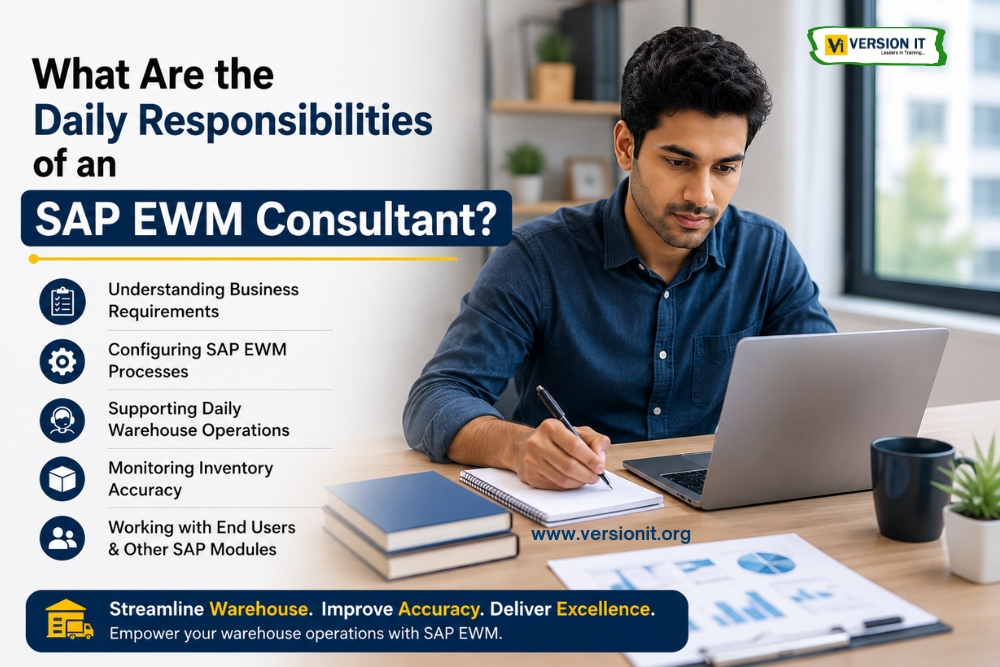
Understanding Business Requirements
One of the biggest responsibilities of an SAP EWM consultant is understanding business requirements.
Warehouse operations differ from company to company. For example:
- Manufacturing companies manage raw materials differently
- Retail companies focus more on fast order dispatch
- Logistics companies handle large shipment movements
The consultant must first understand how the company operates before making any system changes.
In daily work, consultants interact with warehouse managers, business users, and operations teams to understand:
- Current warehouse challenges
- Inventory movement process
- Picking and packing flow
- Storage strategies
- Goods receiving procedures
This business understanding is very important because SAP configuration depends completely on operational requirements.
Configuring SAP EWM Processes
Another major responsibility is system configuration.
SAP EWM consultants configure warehouse processes inside SAP according to business needs.
Some common configuration activities include:
- Warehouse structure setup
- Storage type configuration
- Bin management
- Putaway strategies
- Picking strategies
- Warehouse process types
- Queue management
For example, if a company wants fast-moving products stored near dispatch areas, the consultant configures warehouse rules accordingly.
This configuration work helps businesses improve warehouse efficiency and reduce manual effort.
Supporting Daily Warehouse Operations
In many organizations, SAP EWM consultants work on support projects where daily issue handling becomes an important responsibility.
Warehouse users may face problems like:
- Inventory mismatch
- Failed goods movement
- Picking errors
- Delivery processing issues
- RF device errors
- Stock update delays
When these problems occur, consultants analyze the issue and provide solutions quickly.
Since warehouse operations run continuously, resolving issues on time becomes very important. Delays in fixing warehouse problems can affect shipments and customer deliveries.
This practical problem-solving aspect is a major part of an SAP EWM consultant’s routine work.
Monitoring Inventory Accuracy
Inventory management is one of the most sensitive areas inside warehouse operations.
SAP EWM consultants regularly monitor:
- Stock consistency
- Inventory discrepancies
- Physical stock verification
- Bin accuracy
- Goods movement records
If inventory data inside SAP does not match actual warehouse stock, businesses may face operational confusion.
Consultants help identify the root cause behind such mismatches and ensure inventory records remain accurate.
Many companies depend heavily on SAP EWM consultants during cycle counting and physical inventory activities.
Coordinating with Other SAP Modules
SAP EWM does not work alone. It integrates with multiple SAP modules such as:
- SAP MM
- SAP SD
- SAP PP
- SAP QM
An SAP EWM consultant often coordinates with consultants from these modules during daily activities.
For example:
- Purchase orders from SAP MM connect with goods receipt in EWM
- Sales deliveries from SAP SD trigger warehouse picking
- Production orders from SAP PP require material staging
Understanding these integrations helps consultants support complete business processes smoothly.
This is why many companies prefer consultants who understand both warehouse operations and cross-functional SAP flow.
Working with End Users
Daily communication with end users is another important responsibility.
Warehouse employees may need help with:
- System transactions
- RF scanner usage
- Warehouse tasks
- Inventory posting
- Error messages
Consultants guide users, answer queries, and provide operational support.
Good communication skills become very important here because warehouse users are not always technical experts. Consultants must explain solutions in a simple and practical way.
Testing New Changes and Enhancements
Whenever companies introduce new warehouse processes or system changes, SAP EWM consultants perform testing activities.
Testing includes:
- Process validation
- Stock movement testing
- Inbound and outbound testing
- Integration testing
- User acceptance testing
The purpose is to ensure system changes work correctly without affecting existing warehouse operations.
Even small configuration changes can impact inventory flow, so proper testing is extremely important.
Documentation and Reporting
Another daily responsibility involves maintaining project documentation.
Consultants prepare:
- Process documents
- Configuration documents
- User manuals
- Issue tracking reports
- Testing results
This documentation helps companies maintain system clarity and future project support.
Though documentation may seem simple, it becomes very useful during audits, upgrades, and knowledge transfer activities.
Continuous Learning and System Improvement
SAP EWM keeps evolving with newer technologies and warehouse automation trends.
Modern warehouses now use:
- Barcode systems
- RF devices
- Automated storage systems
- Real-time inventory tracking
- Robotics integration
Because of this, SAP EWM consultants must continue learning regularly.
Many professionals improve their skills through practical SAP EWM Training in Bangalore where they gain exposure to real-time warehouse scenarios and updated SAP technologies.
Career Growth in SAP EWM
The demand for SAP EWM consultants is increasing because companies are investing heavily in warehouse digitization and supply chain automation.
After gaining experience, consultants can move into advanced roles such as:
- Senior SAP EWM Consultant
- Solution Architect
- Warehouse Transformation Specialist
- SAP Supply Chain Consultant
Global demand is also strong because logistics and warehouse management remain critical across industries.
Final Thoughts
The daily responsibilities of an SAP EWM consultant involve much more than simply working on software screens. The role combines:
- Warehouse operations understanding
- SAP system configuration
- Problem-solving
- User support
- Inventory management
- Process improvement
Every day brings different operational challenges, which makes the role practical and dynamic.
For students and professionals interested in warehouse management, supply chain operations, and SAP careers, SAP EWM offers strong long-term opportunities.
With proper learning, practical exposure, and consistent practice through SAP EWM Course in Bangalore, learners can build the skills required to succeed as professional SAP EWM consultants in modern warehouse environments.