
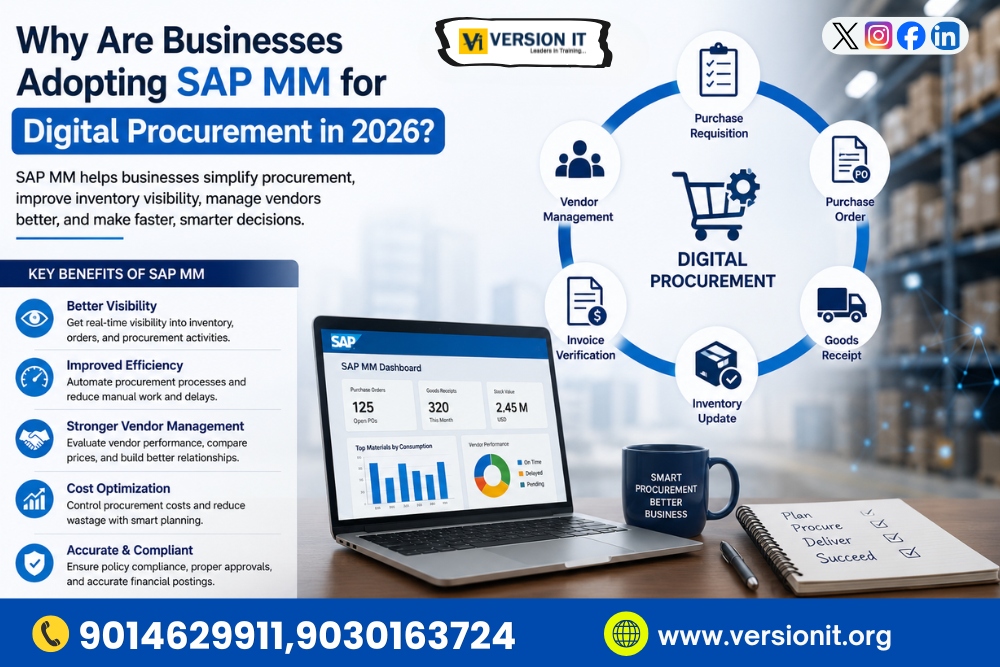
A lot of companies used to handle procurement in a very simple way earlier. One team would raise a request, another team would contact vendors, and someone from accounts would manually verify bills and approvals. For smaller businesses, that setup worked for some time.
But now things have changed.
In 2026, businesses are moving much faster than before. Orders are increasing daily, supply chains are becoming more complicated, and customers expect quick delivery without delays. Because of this, companies can no longer depend completely on manual procurement activities.
This is where SAP MM is becoming more important.
Many organizations are now using SAP MM to manage purchasing, inventory, material tracking, and vendor-related activities in a more organized way. Instead of depending on multiple spreadsheets or separate tools, companies prefer handling everything inside one connected system.
That’s also one reason why interest in SAP MM Training in Pune is growing among students and working professionals who want to understand how digital procurement works in real companies.
Procurement Is No Longer Just About Purchasing Materials
Earlier, procurement mainly meant buying materials whenever required.
Now businesses look at procurement differently.
Today procurement affects:
- Production timelines
- Inventory planning
- Delivery schedules
- Vendor relationships
- Overall business costs
If procurement is delayed, everything else gets delayed too.
For example, if raw materials don’t arrive on time:
- Production teams cannot continue work
- Customer deliveries get postponed
- Companies lose time and money
That’s why businesses are giving much more importance to procurement systems than before.
Companies Want More Control Over Inventory
One major problem many businesses face is inventory imbalance.
Sometimes companies buy excess stock because they don’t have proper visibility. Later that stock remains unused in warehouses for months.
Other times companies suddenly run out of important materials because inventory tracking was poor.
Both situations create problems.
Businesses now want systems where they can clearly see:
- Current stock levels
- Fast-moving materials
- Pending purchase orders
- Material consumption trends
SAP MM helps companies monitor these things properly.
This makes inventory planning easier and helps businesses avoid unnecessary purchasing mistakes.
Manual Processes Create Too Much Confusion
In many companies, procurement activities still involve emails, phone calls, approvals, and manual updates between departments.
When operations grow larger, confusion also increases.
Sometimes:
- Two teams may raise the same purchase request
- Vendor communication gets delayed
- Approval status becomes unclear
- Goods receipt entries are missed
Employees then spend extra time correcting mistakes instead of focusing on actual work.
SAP MM helps reduce this confusion because the process becomes more systematic.
Once information is entered into the system, teams can track everything more clearly.
That improves coordination between procurement, warehouse, finance, and management teams.
Faster Procurement Is Becoming Necessary
Business speed has increased a lot in recent years.
Companies cannot wait several days just to process internal procurement approvals anymore.
Customers expect quick service, and businesses need materials ready without unnecessary delay.
SAP MM helps companies speed up procurement flow.
For example:
- Purchase requests can move through approval stages faster
- Vendor information is already available inside the system
- Material availability becomes easier to check
- Inventory updates happen automatically
This saves time for employees and reduces operational delays.
Many businesses adopting SAP MM are mainly trying to improve efficiency without increasing manual workload.
Vendor Management Has Become More Important
Earlier businesses usually worked with fewer suppliers. Managing vendors manually was easier.
Now companies often work with multiple vendors across different locations.
Tracking all vendor-related details manually becomes difficult after some point.
Businesses need to monitor:
- Vendor delivery performance
- Pricing agreements
- Pending orders
- Payment status
Without proper tracking, procurement teams may struggle with delays and communication gaps.
SAP MM helps organize vendor information properly inside the system.
This allows businesses to compare suppliers, monitor performance, and improve purchasing decisions more effectively.
Real-Time Information Helps Management
One thing companies want today is visibility.
Management teams don’t want to wait until the end of the week to understand procurement issues.
They want real-time updates.
SAP MM allows businesses to track:
- Pending purchase orders
- Inventory shortages
- Procurement expenses
- Delayed deliveries
This helps managers take faster decisions whenever issues happen.
For example, if stock levels suddenly drop for an important material, procurement teams can immediately start purchasing activities before production gets affected.
That kind of visibility becomes very useful in large organizations.
Businesses Prefer Connected Systems
Another reason companies are adopting SAP MM is integration.
Procurement doesn’t work separately anymore.
It connects with:
- Finance
- Inventory management
- Warehouse operations
- Production planning
When businesses use disconnected systems, employees often repeat the same work multiple times in different departments.
That creates unnecessary effort and mistakes.
SAP MM connects procurement activities with other business processes automatically.
For example:
- When materials are received, inventory updates happen immediately
- Financial entries also get recorded
- Warehouse teams receive updated stock information
This improves overall coordination inside the company.
Digital Procurement Supports Business Expansion
As companies grow, procurement activities naturally become more complex.
A business handling 50 purchase orders monthly is very different from a business handling thousands of procurement transactions.
Manual systems become difficult to manage at that level.
SAP MM helps businesses scale procurement operations more smoothly.
The system supports:
- Multiple locations
- Large inventory volumes
- Centralized purchasing
- Structured approval flow
That’s why both mid-sized companies and large enterprises are investing more in digital procurement systems now.
Demand for SAP MM Professionals Is Increasing
Because businesses are adopting SAP MM more actively, companies also need skilled professionals who understand procurement processes and SAP systems.
After learning SAP MM, people usually explore opportunities in:
- SAP MM Consulting
- Procurement Operations
- Inventory Management
- SAP Functional Support
Many learners are choosing SAP MM Training in Pune because procurement and supply chain roles are becoming more stable and practical career options.
Since almost every industry depends on materials and purchasing activities, SAP MM skills continue to stay relevant.
Final Thoughts
Businesses in 2026 are focusing heavily on speed, accuracy, and operational control.
Older manual procurement methods are becoming difficult to manage as companies grow larger and supply chains become more demanding.
SAP MM helps businesses handle procurement activities in a more organized and connected way.
It improves:
- Inventory visibility
- Purchasing efficiency
- Vendor coordination
- Procurement tracking
- Decision-making
That is why many organizations are moving toward SAP MM for digital procurement.
For students and professionals planning to build a career in SAP and supply chain management, learning through practical SAP MM Course in Pune can help develop strong real-time understanding and open long-term career opportunities