
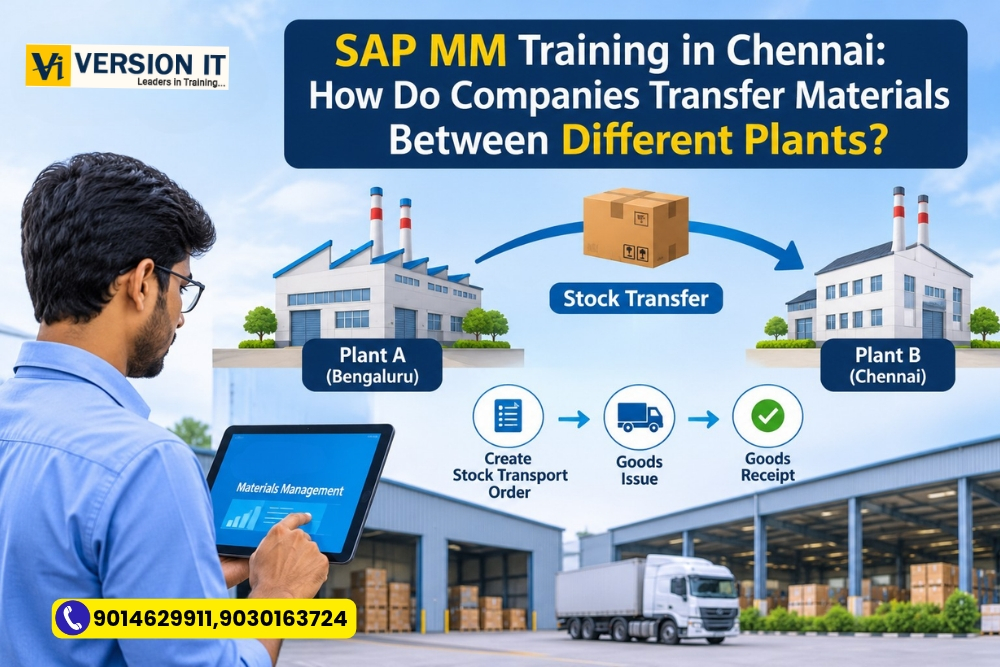
There can be multiple manufacturing plants in various locations. The plant could be producing products, another one could be packaging, and another one could be supplying finished goods to customers nearby. These facilities are part of the same organisation, but are not necessarily equipped with the right materials when they are needed.
For instance, if a manufacturing process in Chennai has a shortage of a component but the same manufacturing company has its plant in Bengaluru, where there is ample supply of the same. The company can choose to shift the available quantity of material from Bengaluru to Chennai instead of buying the same from the external supplier.
This is where SAP Materials Management (SAP MM) comes in handy. It aids businesses with managing transfers of stock, tracking the movement of materials and keeping up to date with stock info at various locations.
If you are planning to join SAP MM Training in Chennai, it is good to understand this process as it enables you to learn inventory management beyond the normal buying and goods receipt transactions.
Why Would One Plant Send Materials to Another?
Material transfers take place for a number of business reasons. Excess stock may exist at one location and an immediate requirement at another. There are times when production schedules are adjusted, when customers order more or when there is an unplanned shortage in one of the plants.
Suppose there are two manufacturing sites in a company:
- In Bengaluru, there are 500 units of a component in plant A.
- Plant B at Chennai has requirement of 150 units.
- The purchasing department doesn’t want to send out an unnecessary purchase order.
If the company has a business process and system configuration that allows it to do so, the company may have an internal transfer of shares.
This facilitates the efficient utilization of the stock at hand for the organisation. It also provides the purchasing and warehouse teams with increased visibility on availability of materials.
The Material’s Journey Through SAP MM
An inter-plant stock transfer isn’t just a logistics operation of transferring boxes from one warehouse to another. This movement should also be entered into the SAP system.
The following is a typical stock transport process.
1. Identify the Material Requirement
The receiving plant determines what material and amount is needed. The team assesses if the material can be sourced from another plant as well as if it is suitable for transfer.
2. To create a Stock Transport Order.
A Stock Transport Order (STO) is used to order materials from another plant.
The STO includes data like supplying plant, receiving plant, material number, quantity, etc. and data related to delivery.
This is not a normal purchase order from an outside vendor, but rather an internal one from a different plant.
3. Material for Dispatch
When a transfer request is accepted, the supplying plant will prepare the requested amount.
A delivery document can also be generated depending on the company’s configuration and process. Then the warehouse team is responsible for picking and preparing the articles for dispatch.
4. Record the Goods Issue
The goods issue is made in SAP when the material leaves the supplying plant.
This will update the inventory records and show the material has been dispatched.
The exact type of movement will vary depending on the stock transfer process used. Example: Goods issue for a stock transport order with a delivery: 641
5. Transfer the Material to the Destination
The receiving plant’s warehouse receives the shipment and verifies the amount received, marking the goods received.
Movement type 101 is generally used for goods receipt on a stock transport order.
The stock from the receiving plant is updated on receiving the stock, as per the respective plant stock and configuration settings.
Understand what Stock in Transit is and why it is important.
An important principle being used in interplant transfers is the stock in transit.
If Bengaluru sends 150 units to Chennai on Monday, how many units does it have then?If Bengaluru sends 150 units to Chennai on Monday, how many does it have in Bengaluru? Tuesday is the earliest that the goods can arrive. At this time the material is in transit from the supplying plant but not at the destination plant.
The business will still have to take those materials into account.
Stock in transit provides visibility of goods sent out for delivery but not received. It’s important because the sending and receiving team could be situated in separate locations.
If there is no tracking done, the supplying plant may think that it has delivered the goods and the receiving plant may not have entered the receipt date.
Students need to be aware that goods issue and goods receipt are two distinct business activities. Simply recording one does not imply that the other has been recorded.
Stock Transfer Between Plant vs Transfer Within a Plant
Both these activities seem to be alike, but they are used for different purposes.
Transfer within a plant could be a shift from one storage to another. For instance, stock might be moved from a primary stock warehouse to a manufacturing stock area.
Inter plant transfer – 2 different plants. May need a stock transport order and more dispatch and receive work.
Helping students to identify this difference prevents them from considering all inventory transactions in the same manner, which is necessary to choose the correct process to align with the business requirement.
Learn to write a practical exercise in SAP MM students.
Imagine that a company operates plants in Chennai and Pune. There are 300 units of a material in the Pune plant and 80 units in the Chennai plant.
It would be a great exercise to go through the transfer process in a practice SAP environment.
These activities can be used by students to work through:
- Determine supplying and receiving plants.
- Review the material and stock on hand.
- Prepare a stock transport order for the desired number of items.
- Be familiar with the delivery and goods issue process.
- Point out the importance of stock in transit in the system.
- Post Goods receipt at receiving plant.
- Look for new stock at both of these places.
Once students have finished, they should examine the document flow and what the implications of each stage are for inventory.
This type of practice will make it easier to correlate the actual movement of materials within the company with SAP transaction activities.
What skills can students acquire during this process?
When transferring stocks between plants, a few important concepts of SAP MM are introduced. Students will learn about:
- Plant and storage location structures.
- Material master data.
- Stock Transport Orders.
- Goods Issue and Goods receipt.
- Movement types.
- Stock in transit.
- Inventory monitoring, material documents.
- Purchase and inventory management.
These are helpful when understanding the relationship of purchase, warehouse and inventory.
Pupils should also be aware of how to check the details of a document and recognise that a transaction is incomplete. Stock information is shared with the purchasing, production, warehouse and finance teams and that’s why it’s important to have accurate documentation in a real business.
SAP MM Basic Practical Business Scenarios at Version IT
Version IT offers students an opportunity to develop their knowledge of material management through structured learning and hands-on exercises in SAP MM Training in Chennai.
Learning shouldn’t just be about creating purchase orders. Students gain insights into the flow of materials through various business processes, the updating of inventory records and how purchasing activities relate to the work in the warehouse.
Students need to investigate the syllabus, trainer’s experience, access to a practical system and business scenarios covered in training sessions prior to selecting a training programme.
Final Thoughts
The shortage of materials at a company’s plant does not necessarily mean that the company has to buy new materials. In many instances, available stock can be made available from another location via a suitable internal process.
SAP MM enables the recording of this movement, the tracking of materials shipped and the update of inventory when the receiving plant accepts the goods.
If a student is learning SAP MM, stock transport orders and inter plant transfers give a real-life perspective of a material being handled by a large organisation across various locations. It’s a good idea to grasp first before you go to higher-level inventory and procurement.