
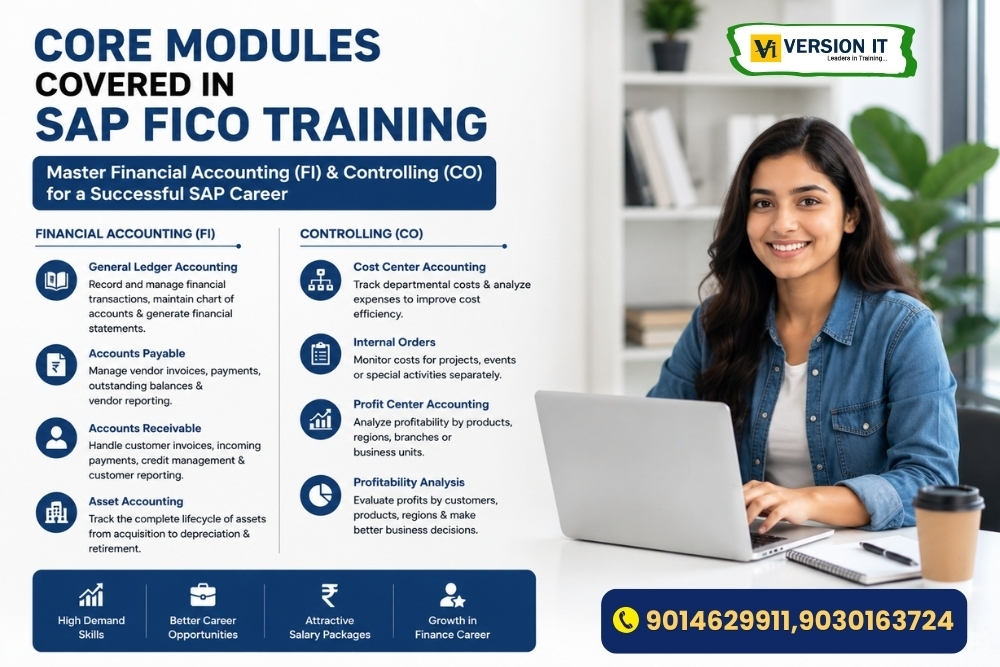
If you’re planning to build a career in SAP, one of the first modules you’ll probably hear about is SAP FICO. Whether you’re a commerce graduate, an accountant, an MBA student, or someone already working in finance, SAP FICO is often considered one of the most valuable SAP modules because it is directly connected to a company’s financial operations.
But before joining a course, most people have one common question: What exactly is covered in SAP FICO training?
It’s a fair question. After all, nobody wants to invest their time and money without understanding what they will learn. Many beginners assume SAP FICO is only about accounting entries and financial reports. It’s much broader than that. It helps businesses manage their finances, monitor costs, analyse profitability, and make better decisions.
What makes SAP FICO interesting is that it doesn’t just teach software navigation. It teaches how businesses function from a financial perspective. That’s one reason why companies continue to hire skilled SAP FICO professionals across industries.
Understanding SAP FICO in Simple Terms
The term SAP FICO is made up of two important components:
FI – Financial Accounting
CO – Controlling
Both modules work together but serve different purposes.
Financial Accounting focuses on recording and reporting financial transactions. Controlling focuses on planning, tracking, and analyzing costs within the organization.
Think of FI as the module that tells the company what happened financially, while CO helps management understand why it happened and how performance can be improved.
During training, both areas are covered in detail because they are closely connected in real business environments.
Financial Accounting (FI)
Financial Accounting is usually the first area learners are introduced to during SAP FICO training.
Every company, regardless of its size, records thousands of financial transactions every month. These transactions need to be organized properly so that management can monitor financial health and comply with accounting regulations.
General Ledger Accounting
One of the most important topics within FI is General Ledger Accounting.
If you’ve studied accounting before, you’ve probably heard the term “General Ledger.” In SAP, it becomes the central location where financial transactions are recorded and managed.
During training, learners understand how companies create account structures, maintain chart of accounts, post transactions, and generate financial statements.
Although it sounds technical initially, this topic becomes easier once you start working with practical examples.
Accounts Payable
Every organization purchases goods or services from suppliers. These transactions need to be tracked properly.
Accounts Payable deals with everything related to vendor payments.
You’ll learn how businesses manage vendor invoices, payment processing, outstanding balances, and vendor-related reporting.
Many students enjoy this topic because it closely reflects everyday business operations. It gives a practical understanding of how companies manage relationships with suppliers while maintaining financial accuracy.
Accounts Receivable
Just as companies pay vendors, they also receive payments from customers.
Accounts Receivable focuses on customer transactions, customer invoices, incoming payments, and credit management.
One of the reasons this topic is important is because cash flow plays a major role in business success. SAP helps organizations monitor customer balances and ensure payments are collected on time.
This is one area where learners begin to understand how finance impacts overall business performance.
Asset Accounting
Every business owns assets. These may include machinery, vehicles, computers, office equipment, buildings, or manufacturing tools.
Managing these assets manually can become difficult as organizations grow.
SAP Asset Accounting helps companies track the complete lifecycle of an asset, from acquisition to depreciation and eventual retirement.
For learners, this topic provides valuable insight into how businesses manage long-term investments.
Moving Towards Controlling (CO)
After understanding Financial Accounting, training gradually moves into Controlling.
Many students initially think CO is complicated. However, once practical examples are introduced, it becomes one of the most interesting parts of SAP FICO.
While FI records financial information, CO helps management analyze and control costs.
This information supports decision-making at different levels of the organization.
At this stage, students attending SAP FICO Training in Pune often begin to see how SAP is not just an accounting tool but a complete business management solution.
Cost Center Accounting
Every department within a company spends money.
Human Resources, Marketing, IT, Administration, and Operations all generate costs.
Cost Center Accounting helps businesses track where money is being spent and evaluate whether those expenses are justified.
For example, management can compare departmental expenses and identify areas where cost optimization may be possible.
This module is widely used in organizations because controlling expenses is a critical business objective.
Internal Orders
Not all expenses belong to permanent departments.
Sometimes companies run temporary projects, special events, promotional campaigns, or short-term initiatives.
Internal Orders help track costs related to these specific activities.
During training, learners understand how businesses use Internal Orders to monitor project expenses separately from regular operational costs.
This topic becomes especially useful for those interested in project-based financial management.
Profit Center Accounting
Every organization wants to know which business areas are generating profits.
Profit Center Accounting allows companies to analyze profitability across different products, regions, branches, or business units.
This information helps management make better strategic decisions.
For example, a company may discover that one product line generates significantly higher profits than another. Such insights are valuable when planning future investments and business growth.
Profitability Analysis
One of the most practical and business-focused topics within SAP FICO is Profitability Analysis.
This module helps answer important questions such as:
- Which customers generate the highest revenue?
- Which products are most profitable?
- Which regions perform best?
- Where should the company focus its resources?
Understanding profitability helps businesses make smarter decisions and improve overall performance.
Many experienced SAP professionals consider this one of the most powerful areas within SAP FICO because it connects financial data directly with business strategy.
Why These Modules Matter
One thing I often tell people is that SAP FICO training isn’t only about learning transactions and configuration screens.
The real value comes from understanding how businesses manage money, monitor costs, and evaluate performance.
When you learn General Ledger, Accounts Payable, Accounts Receivable, Asset Accounting, Cost Centers, Internal Orders, Profit Centers, and Profitability Analysis, you gain a much broader understanding of business operations.
This is exactly why SAP FICO professionals remain in demand across industries.
Conclusion
SAP FICO training covers a wide range of financial and controlling functions that are essential for modern businesses. From managing daily accounting transactions to analyzing profitability and controlling costs, every module plays an important role in helping organizations operate efficiently.
For anyone planning a career in SAP, understanding these core modules provides a strong foundation for future growth. The combination of Financial Accounting and Controlling not only builds technical SAP knowledge but also develops a deeper understanding of how businesses make financial decisions.
If you’re looking to enter the SAP domain or strengthen your finance career, enrolling in SAP FICO Course in Pune can be a great step toward learning these practical concepts and preparing for real-world business challenges. As organizations continue to rely on SAP for managing financial operations, professionals with SAP FICO expertise will continue to find strong career opportunities in the years ahead.