
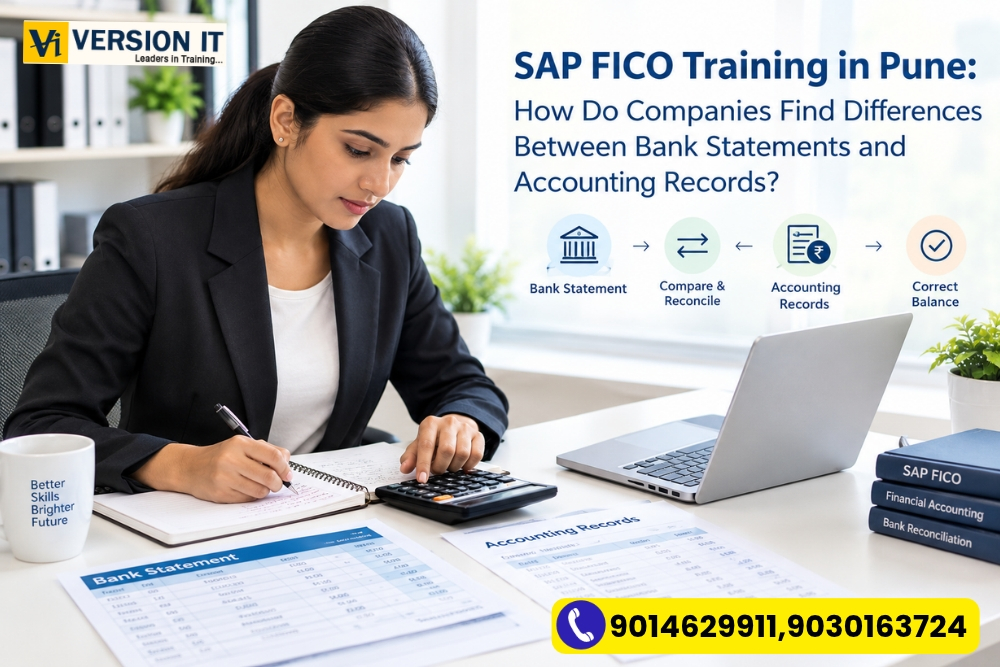
It is possible for a firm to post a customer payment in the accounting system today but have the payment not show up in the bank statement until tomorrow or the next day. In another scenario, the bank could charge a service fee that the accounts staff has not entered into the system. Such differences may cause the bank balance reflected on the books of the company to be different than the balance reflected by the bank.
An accounts professional needs to know why these disparities are occurring for accounts to be closed. This is known as bank reconciliation.
A student of SAP FICO Training in Pune can gain knowledge about how the financial accounting records, bank transactions and reconciliation activities dovetail into each other. It is also instructive to the student to grasp the reasons behind the importance of keeping accurate accounting records in normal business transactions.
What causes the discrepancy between the bank balance and the accounting balance?
Suppose that a firm sells office equipment to a number of customers. During the last 7 days of a month, the accounts team is responsible for processing all the receipts from customers, making sure that suppliers are paid and the expenses of employees are taken care of.
When the accountant checks the bank statement, the closing balance is ₹4,85,000. The balance in the bank however is shown in the Company’s books as ₹ 4,92,000.
There is a difference of ₹7,000.
The difference does not automatically mean that someone has made a mistake. A cheque might be uncleared, a bank charge might not yet have been entered into the books, or a transaction could have been entered at a different date.
Before determining if an adjustment is needed, the accountant should investigate each item. Resolving the issue would not occur if only the accounting balance is made to tally with the bank statement.
Bank Reconciliation in SAP FICO – What is it?
Bank reconciliation is the process of matching the company’s accounting records to its bank statement.
It’s intended to uncover transactions that are not in one record but in the other, look for discrepancies and make sure that the balances at the end are supported.
Bank transactions can be entered and viewed in the general ledger and corresponding bank accounts in SAP Financial Accounting. Electronic bank statement processing can also be used to import bank transactions, match them with the company’s transactions and process those that need special attention.
The process will vary depending on the SAP version, system configuration, and the banking process of the company.
Students in SAP FICO Training in Pune should not only know the transaction codes, but also learn the accounting logic behind the transactions.
The bank reconciliation differences are explained below:
Several common transactions can give insight as to why the bank statement and accounting ledger may not match from the start.
1. The money that the bank charges for activities that are not written in the bank’s records.
Assume that the bank charges ₹1500 as a maintenance charge and transaction fee. If this charge has not been recorded by the accountant, then the bank balance will be less than the balance in the books of the company.
Once it has been confirmed, then the accountant can make the correct entry in Expense book and bank.
2. Uncleared payments.
A company may make a supplier payment of ₹20,000 and make an entry in its books for the payment. But the bank can clear the payment at a later time.
The two records can have different balances until the transaction is reflected in the bank statement. The accountant should verify if the payment is pending or not, and not make a second payment.
3. Later receipts that are given to customers
Near the end of the working day, a customer can transfer funds. The bank statement does not show the receipt until the day after it is recorded by the accounting team.
The accountant should review the reference and posting dates on the transaction to determine the difference is just a timing issue.
4. Incorrect/duplicate entries.
A sale could be on for the incorrect quantity, the incorrect account or double posted. When initial transaction is verified these differences should be researched and rectified.
With such knowledge, learners can identify what they consider to be normal timing differences and what they believe is a true accounting error.
How does SAP benefit the bank reconciliation process?
The reconciliation process typically starts by examining the bank statement and the transactions on the bank statement.
If the bank statement processing is e-enabled, the data on the bank statement can be loaded into SAP. Matching rules can be set to match transactions and to decide the proper treatment for posting.
An example of such a statement is a bank statement where the customer receives ₹35,000. The system can try to match the transaction with an existing accounting entry based on the available references and the configured criteria.
In the case of a successful match, the matching item may be processed as per the company’s reconciliation process. The accountant may have to perform a manual investigation if the reference is ambiguous or the amount is inconsistent.
SAP is not an accounting judgment killer. There are a number of factors that impact the ability to process transactions, such as matching rules, master data quality, transaction references, and system configuration.
Students should be taught, therefore, how to check unmatched items and how the accounting effects of any proposed change are realized.
The bank reconciliation is a useful exercise for students to do, both practically and conceptually.
Let’s imagine the following example:
- Book value of the company: ₹4,92,000
- Balance shown in the bank statement: ₹4,85,000
- Bank charges (which have not yet been entered in the books): ₹1,500
- Supplier payment in book but not in bank: ₹5500
Students should first determine why there might be a difference between the two balances. They should then figure out the impact that each item has on the reconciliation.
The ₹1,500 bank charge is deducted from the company’s books after it has been booked. The difference between the supplier payment and the cleared supplier payment is a timing difference, and should not be automatically posted again.
Once these items have been removed, the difference should be explored in light of the available information on the transactions. One good exercise is that you don’t assume that the explanation of any discrepancy is exhausted.
Through this, students will learn to analyse transactions, follow the evidence, and will gain a familiarity of the difference between an accounting adjustment and a timing difference.
What should be learnt in SAP FICO training?
Students should develop a sound knowledge of the following:
- General ledger accounting and bank-related accounts.
- Keeping records of incoming and outgoing payments.
- Processing of electronic bank statements (if included within course).
- Correlating bank transactions with accounting data.
- Recognising the things that are not the same and the investigation of discrepancies.
- Knowing the effect of corrections on financial records.
- Reviewing balances and supporting month end closing activities.
The exercises are particularly beneficial because it gives students an opportunity to see the effect of each individual transaction on the accounting position.
Students should check when they make a decision about a Course if the Course offers hands-on experience with the SAP practical application, if the Course includes samples to reconcile with the bank, and if the Course includes experience with the version and configuration of SAP used during the Course.
Learn Practical Accounting Concepts with Version IT
Bank reconciliation is a crucial accounting task, as it enables companies to maintain accurate financial records and ensure that their payments are processed correctly.
If you are thinking of taking the SAP FICO Training in Pune, it is important that you understand the process, because the basics of general ledger accounting, bank transactions, and financial control procedures, are important.
Version IT offers training in the area of SAP for students who are interested in enterprise software and enterprise processes. Students have the opportunity to read the existing syllabus, the practical training method, the trainer’s experience and the chance to solve practical accounting scenarios.
Understanding why bank balances vary and how to find out if they are varying is an exercise in real practical work which will help you to understand how financial accounting works within a business.