
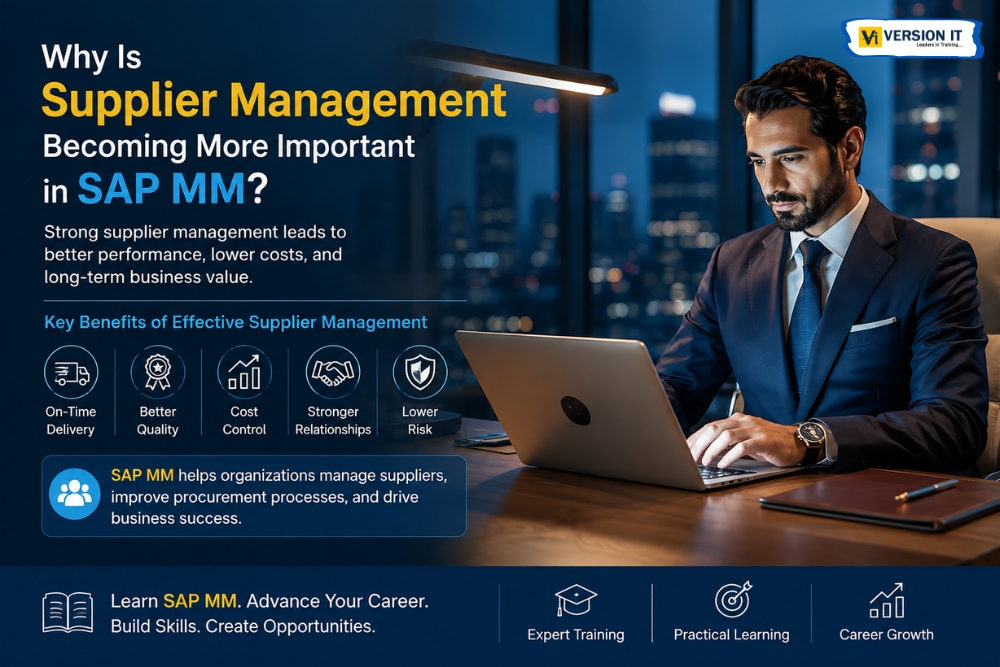
Procurement is no longer limited to creating purchase orders and receiving materials. For many businesses, suppliers have become an important part of overall operations. A delayed shipment can affect production, poor-quality materials can create customer complaints, and unexpected price changes can influence profitability. Because of this, organizations need better ways to manage supplier relationships and purchasing performance.
SAP MM plays an important role in connecting purchasing activities with materials, inventory, suppliers, and other business functions. As procurement processes become more strategic, supplier management is becoming an increasingly important area for SAP MM professionals to understand.
For learners building their SAP career, SAP MM Training in Chennai can provide a strong foundation in procurement and materials management while helping them understand how supplier-related activities fit into the larger purchasing process.
Supplier Management Is More Than Vendor Selection
Choosing a supplier is only the beginning of a procurement relationship.
Once a supplier is selected, the organization needs to monitor several factors, including delivery performance, product quality, pricing, communication, and consistency.
A supplier that offers a low price but regularly delivers late may create greater costs for the business. Similarly, a supplier with good delivery performance but inconsistent quality can create production and customer-service problems.
Modern procurement therefore looks at the overall value a supplier provides rather than focusing on price alone.
Why Supplier Performance Matters
Supplier performance directly affects business operations.
Imagine a manufacturing company waiting for a critical component. If the supplier misses the agreed delivery date, production may slow down or stop. The purchasing team then has to spend additional time following up, finding alternatives, or changing delivery plans.
With better supplier monitoring, organizations can identify recurring problems and take corrective action earlier.
Important performance areas can include:
- On-time delivery
- Material quality
- Order accuracy
- Pricing consistency
- Response time
- Contract compliance
- Supply reliability
This information helps procurement teams make more informed decisions.
Better Supplier Data Improves Procurement
Supplier management depends heavily on accurate information.
If supplier records are incomplete, outdated, or inconsistent, procurement teams may face difficulties during purchasing activities.
SAP MM professionals should understand the importance of maintaining reliable supplier-related master data.
Accurate information can help organizations manage purchasing processes more efficiently and reduce unnecessary errors.
It also creates a better foundation for reporting and supplier evaluation.
Supplier Management and Inventory Planning
Supplier performance is closely connected to inventory management.
When suppliers deliver consistently, businesses can plan inventory more effectively. When deliveries are unpredictable, companies may need to maintain additional stock as a safety measure.
That additional inventory can increase storage and carrying costs.
This is why procurement teams need to look beyond individual purchase orders. They must understand how supplier lead times and delivery patterns affect inventory planning.
SAP MM professionals who understand this connection can better support businesses in improving procurement and inventory processes.
Managing Supplier Risk
Every organization faces some level of supplier risk.
A company may depend heavily on a single supplier for a critical material. Another supplier may operate in a region affected by transportation problems or other disruptions.
Supplier management helps organizations identify these risks and prepare appropriate strategies.
For example, businesses may evaluate whether alternative suppliers are available or whether certain materials require additional planning.
SAP MM professionals can contribute to these processes by understanding purchasing data and how supplier information connects with material requirements.
Supplier Relationships Are Becoming Strategic
Procurement teams are increasingly expected to work with suppliers as long-term business partners rather than treating every purchase as a separate transaction.
Strong supplier relationships can help businesses negotiate better terms, improve communication, solve quality problems, and respond faster when requirements change.
For strategic suppliers, regular performance reviews and clear communication can create mutual benefits.
This approach is especially useful for organizations that depend on suppliers for important materials or services.
The Role of Technology in Supplier Management
Technology has made it easier for organizations to collect and analyze procurement information.
Instead of relying entirely on spreadsheets or manual follow-ups, businesses can use digital procurement processes to gain better visibility into supplier activities.
SAP environments can connect purchasing information with other business processes, allowing organizations to understand what has been ordered, what has been received, and what remains outstanding.
This visibility can help procurement teams identify issues earlier.
Supplier Management and Cost Control
Cost management is another reason supplier management has become important.
The purchase price of a material is only one part of the overall cost.
Late deliveries, poor-quality materials, emergency purchases, additional transportation, and excess inventory can all create hidden costs.
A supplier that appears inexpensive initially may become expensive if its performance creates repeated operational problems.
By evaluating suppliers based on broader performance measures, procurement teams can make decisions that support long-term cost control.
How Supplier Management Supports Better Decision-Making
Good supplier information allows procurement teams to answer practical questions.
For example:
- Which suppliers consistently deliver on time?
- Which suppliers have repeated quality problems?
- Which materials depend on a single supplier?
- Where are purchasing costs increasing?
- Which supplier relationships require attention?
- Are contractual conditions being followed?
Answers to these questions can help procurement managers make better decisions.
SAP MM professionals should therefore understand how transactional purchasing information can contribute to broader procurement analysis.
Supplier Management and Procurement Automation
Modern procurement processes increasingly use workflow and automation for repetitive activities.
Approvals, purchasing requests, notifications, and other routine processes can be structured to reduce manual effort.
Supplier-related information can also support automated monitoring and exception handling.
For example, when a purchasing activity requires additional approval or attention, the appropriate workflow can help direct it to the responsible person.
Automation does not eliminate the need for procurement professionals. Instead, it allows them to spend more time on supplier negotiations, problem-solving, and strategic decisions.
Why SAP MM Professionals Should Understand Supplier Management
SAP MM professionals often work closely with procurement processes.
Understanding only the technical steps of creating purchase orders is no longer enough for many modern SAP projects.
Professionals should also understand the business reasons behind purchasing activities.
Useful areas include:
- Supplier master data
- Purchasing processes
- Purchase requisitions
- Purchase orders
- Source determination
- Contracts
- Scheduling agreements
- Goods receipts
- Invoice verification
- Supplier performance
- Inventory integration
- SAP MM-FI integration
A practical SAP MM Course in Chennai can help learners understand these areas through business-oriented scenarios instead of learning procurement as a collection of isolated transactions.
Practical Knowledge Makes a Difference
Supplier-related issues are often unpredictable.
A project may involve a supplier who repeatedly delivers late, a material that fails quality checks, an incorrect purchase order, or an invoice that does not match the received quantity.
Working through such situations can help learners understand how SAP MM supports real procurement operations.
At Version IT, learners can develop practical SAP MM knowledge while understanding how procurement activities connect with inventory, finance, and supplier-related business processes.
Preparing for Modern Procurement Roles
The growing importance of supplier management creates opportunities for SAP MM professionals who understand the wider procurement lifecycle.
Organizations need professionals who can understand business requirements, configure or support SAP processes, analyze purchasing information, and communicate effectively with procurement teams.
Professionals who combine SAP MM knowledge with an understanding of supplier performance, procurement analytics, inventory planning, and process improvement can be better prepared for modern SAP projects.
Conclusion
Supplier management has become more important in SAP MM because supplier performance can directly influence inventory availability, production continuity, product quality, costs, and customer satisfaction. Organizations therefore need better visibility into supplier relationships and purchasing performance.
For SAP MM professionals, this means developing knowledge beyond basic procurement transactions. Understanding supplier data, purchasing processes, inventory connections, supplier risk, performance monitoring, and procurement automation can help professionals contribute more effectively to business projects.
Starting with SAP MM Training in Chennai can help learners establish the fundamentals of SAP procurement. A practical SAP MM Course in Chennai can then connect those concepts with real-world supplier and purchasing scenarios, while the right SAP MM Training Institute in Chennai can support learners in building practical skills for modern SAP procurement roles.