
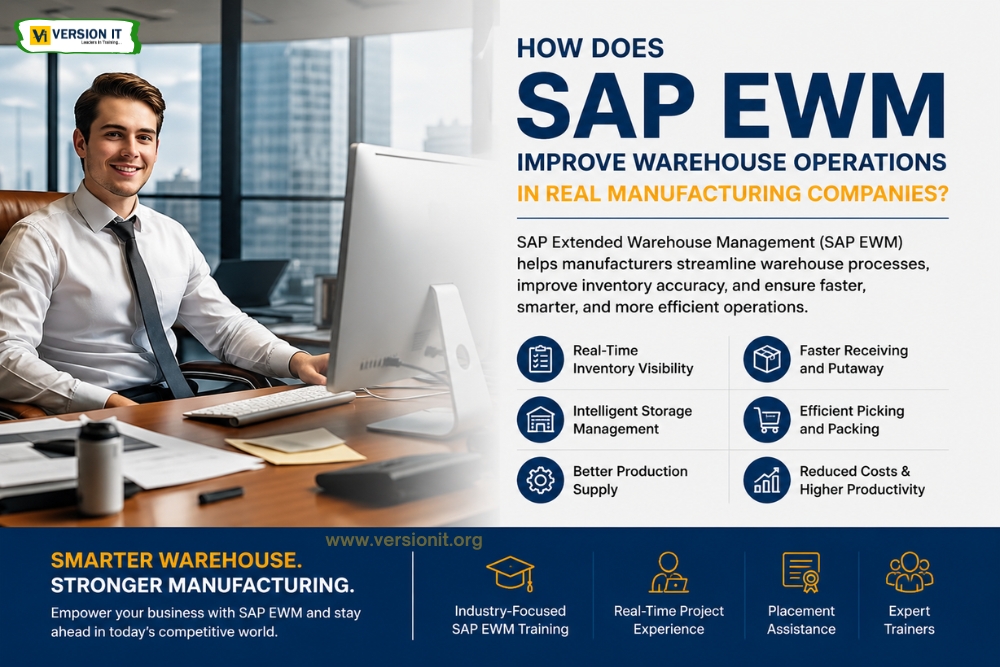
Warehouse operations have become far more complex than they were a decade ago. Manufacturing companies now deal with thousands of products, multiple suppliers, faster customer expectations, and tighter delivery schedules. Managing inventory manually or through outdated warehouse systems often leads to delays, stock mismatches, and higher operating costs. As a result, many manufacturers are adopting SAP Extended Warehouse Management (SAP EWM) to streamline warehouse activities and improve operational efficiency.
Professionals who want to understand these advanced warehouse processes often choose SAP EWM Training In Chennai because it provides practical knowledge of how modern manufacturing companies manage inventory, storage, and distribution using SAP technologies.
Why Warehouse Efficiency Matters in Manufacturing
Every manufacturing company depends on a well-organized warehouse. Raw materials must arrive on time, production teams need uninterrupted material availability, and finished products should reach customers without delays.
Even a small warehouse mistake can create significant business problems, such as:
- Production interruptions
- Inventory shortages
- Incorrect shipments
- Increased operating costs
- Customer dissatisfaction
- Delayed deliveries
Manufacturers therefore require intelligent warehouse systems that provide complete visibility into inventory and support efficient material movement.
SAP EWM helps organizations achieve these goals by automating warehouse operations and improving inventory accuracy.
Better Inventory Visibility
One of the biggest advantages of SAP EWM is real-time inventory visibility.
In traditional warehouse environments, inventory records may not always match the actual stock available on the warehouse floor. This creates confusion during production planning and customer order fulfillment.
SAP EWM provides accurate information about:
- Current stock levels
- Storage locations
- Material availability
- Goods movement history
- Inventory status
Warehouse managers can instantly identify where materials are stored and how much inventory is available.
This level of visibility allows manufacturing companies to make faster and more informed operational decisions.
Faster Goods Receiving Process
Every manufacturing operation begins with receiving raw materials from suppliers.
If the receiving process is slow or inaccurate, production schedules can suffer.
SAP EWM improves inbound logistics by helping warehouse teams:
- Register incoming materials quickly
- Verify purchase orders
- Record goods receipts accurately
- Allocate storage locations automatically
- Reduce manual paperwork
Automation minimizes delays and allows production departments to access materials more efficiently.
Intelligent Storage Management
Manufacturing companies often manage thousands of different items across large warehouse facilities.
Finding the right storage location manually becomes difficult as inventory grows.
SAP EWM optimizes warehouse space by suggesting the most appropriate storage locations based on factors such as:
- Product type
- Storage conditions
- Material dimensions
- Stock availability
- Warehouse layout
This intelligent storage strategy improves warehouse organization while reducing unnecessary material movement.
Employees spend less time searching for products, resulting in higher productivity.
Efficient Picking and Packing Operations
Order fulfillment plays a critical role in manufacturing businesses.
Customers expect fast and accurate deliveries.
SAP EWM improves picking operations through optimized warehouse workflows.
The system can:
- Generate efficient picking routes
- Prioritize urgent orders
- Reduce travel time inside the warehouse
- Improve picking accuracy
- Support barcode scanning
After picking, SAP EWM also assists with packing activities by ensuring products are packed correctly before shipment.
These improvements reduce shipping errors and increase customer satisfaction.
Professionals learning through SAP EWM Course In Chennai often practice these warehouse scenarios because they closely reflect real manufacturing operations.
Improved Production Supply
Manufacturing depends on timely material availability.
Production lines cannot function efficiently if raw materials arrive late.
SAP EWM integrates warehouse activities with production planning, ensuring materials are delivered to manufacturing areas exactly when required.
This supports:
- Continuous production
- Reduced downtime
- Better material availability
- Improved production scheduling
- Higher operational efficiency
Manufacturers benefit from smoother workflows and fewer production interruptions.
Real-Time Warehouse Monitoring
Warehouse managers require accurate information to make operational decisions.
SAP EWM provides dashboards and monitoring tools that display warehouse activities in real time.
Managers can monitor:
- Pending warehouse tasks
- Inventory movement
- Worker productivity
- Equipment utilization
- Delivery status
- Warehouse performance indicators
Access to real-time information enables quicker decision-making and helps resolve operational issues before they affect production.
Better Labor Management
Large manufacturing warehouses often employ hundreds of warehouse workers.
Managing workforce productivity manually can be challenging.
SAP EWM helps organizations assign tasks more effectively by considering:
- Employee availability
- Skill levels
- Work priorities
- Warehouse workload
Balanced task distribution improves employee productivity while reducing unnecessary delays.
Managers also gain valuable insights into workforce performance and operational efficiency.
Seamless Integration with Other SAP Modules
One of the greatest strengths of SAP EWM is its integration with other SAP applications.
Warehouse operations do not function independently.
They interact with multiple business departments, including procurement, production, finance, and sales.
SAP EWM integrates with modules such as:
- SAP MM
- SAP PP
- SAP SD
- SAP QM
- SAP TM
This integration allows information to flow smoothly throughout the organization, reducing duplicate work and improving overall business efficiency.
Reduced Operational Costs
Efficient warehouse management directly impacts business profitability.
SAP EWM helps manufacturers reduce costs by:
- Minimizing inventory errors
- Reducing manual activities
- Improving warehouse space utilization
- Increasing labor productivity
- Preventing stock shortages
- Reducing shipping mistakes
Lower operational costs enable manufacturers to improve profitability while delivering better customer service.
Supporting Digital Manufacturing
Manufacturing companies continue investing in digital transformation initiatives.
Automation, smart factories, IoT devices, and real-time analytics are becoming standard across many industries.
SAP EWM supports these initiatives by providing advanced warehouse capabilities that integrate with modern manufacturing technologies.
Organizations can automate repetitive warehouse tasks while maintaining complete control over inventory and material movement.
As digital manufacturing continues to grow, professionals with SAP EWM expertise remain highly valuable.
Career Opportunities in SAP EWM
The increasing adoption of SAP EWM has created excellent career opportunities for skilled professionals.
Organizations implementing advanced warehouse management solutions require consultants who understand both warehouse operations and SAP technologies.
Career roles include:
- SAP EWM Consultant
- Warehouse Business Analyst
- SAP Functional Consultant
- Logistics Process Consultant
- Supply Chain Consultant
- SAP Support Consultant
Employers often look for candidates who possess practical knowledge of warehouse processes rather than only theoretical concepts.
A quality SAP EWM Training Institute In Chennai helps learners develop hands-on experience through real-time scenarios, warehouse configurations, and business case studies.
At Version IT, students gain practical exposure to warehouse management concepts that closely reflect real manufacturing environments, helping them build confidence for implementation and support projects.
Conclusion
Efficient warehouse management is essential for every manufacturing company. From receiving raw materials to delivering finished products, every warehouse activity influences productivity, customer satisfaction, and business performance. SAP EWM improves these operations by providing real-time inventory visibility, intelligent storage management, automated warehouse processes, production integration, and advanced monitoring capabilities.
For individuals planning to build a career in supply chain management and warehouse automation, enrolling in SAP EWM Training In Chennai is an excellent starting point. A practical SAP EWM Course In Chennai helps learners understand real manufacturing workflows, while choosing a trusted SAP EWM Training Institute In Chennai provides the hands-on experience needed to succeed in today’s growing SAP logistics industry.