
Imagine a finance team closing its books at the end of a month. The accountants are checking general ledger postings, the controlling team is reviewing costs, and management wants to understand profitability. In a traditional ERP environment, these activities could involve different data structures and reconciliation steps. The finance team may need to bring information together before getting a complete picture.
ERP S/4HANA Finance approaches this differently. The Universal Journal brings financial accounting and controlling information together at the journal-entry level, creating a common financial data foundation. For professionals starting or updating their skills, ERP FICO Training in Chennai can be useful for understanding how familiar FICO processes work inside this newer S/4HANA architecture.
Why the Universal Journal Changed the Finance Process
The Universal Journal is built around the ACDOCA table. ERP describes it as the single source of truth for Financial Accounting and Controlling, with accounting-relevant information held together in one line-item structure. This design was introduced to reduce data redundancy, improve transparency, and reduce the reconciliation effort between FI and CO.
The important point is that the Universal Journal is not simply another reporting table. It changes the relationship between several finance processes.
Instead of treating financial accounting and management accounting as completely separate areas, S/4HANA provides a much more integrated foundation.
General Ledger Accounting Gets a More Connected View
General Ledger accounting is one of the areas that benefits most from the Universal Journal.
Financial transactions generate journal entries that contain the relevant accounting information. Because financial and controlling information can be represented together, finance teams can analyze a transaction from both perspectives without relying on the same level of reconciliation that was common in older architectures.
For example, when an expense is posted to a cost center, the accounting impact and the controlling assignment can be represented within the same journal-entry framework.
This gives accountants and controllers a more consistent view of the transaction and makes financial analysis easier.
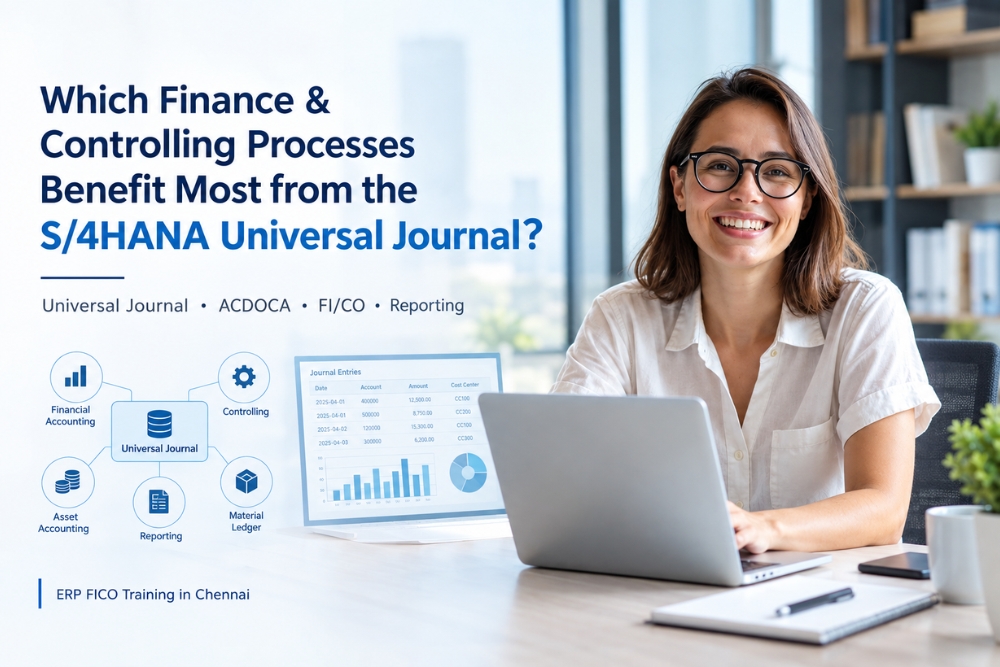
SAP’s current documentation confirms that the Universal Journal integrates General Ledger Accounting, Controlling, Asset Accounting, and Margin Analysis within the common journal structure.
FI and CO Reconciliation Becomes Less Complicated
The relationship between FI and CO is one of the clearest examples of the Universal Journal’s impact.
In older ERP environments, financial accounting and controlling could maintain information in separate physical tables. This separation meant that reconciliation between the two areas was an important activity.
In S/4HANA, FI and CO information is integrated through ACDOCA. ERP explains that real-time FI-CO integration remains essential, but the technical separation is reduced because the information is represented within the same Universal Journal structure.
For a finance professional, this changes the way the process is understood.
The question is no longer simply, “How do I reconcile FI and CO?”
It becomes:
How does one business transaction affect both financial reporting and management accounting?
That is a much more useful way to understand S/4HANA Finance.
Cost Accounting Becomes More Closely Linked to the G/L
Another important change affects cost elements.
In the traditional approach, cost elements were handled as separate CO master data. In the Universal Journal environment, cost elements are treated as a special type of G/L account. SAP’s current Universal Journal FAQ confirms this change in S/4HANA.
This creates a closer relationship between financial accounting and controlling.
For example, when an organization records an operating expense, the financial posting and the relevant cost-accounting information can be viewed through the integrated journal structure.
For controllers, this provides a more consistent financial foundation for cost analysis.
Profitability Analysis Gets Better Data Consistency
Businesses rarely want to know only how much revenue they generated. They also want to understand where that revenue came from and whether particular products, customers, regions, or business segments are profitable.
In ERP S/4HANA, Margin Analysis is integrated with the Universal Journal. ERP identifies Margin Analysis as the fully integrated form of CO-PA within the Universal Journal, while costing-based CO-PA can still be used in parallel.
This can make profitability analysis more closely connected with actual financial postings.
A company may therefore analyze a business transaction from multiple dimensions without depending on separate financial and controlling data foundations.
Asset Accounting Benefits From the Same Financial Foundation
Fixed assets also form an important part of financial management.
Organizations need to track acquisitions, depreciation, transfers, retirements, and other asset-related transactions. Asset Accounting is integrated with the Universal Journal, allowing relevant asset accounting information to participate in the common financial data structure.
This is valuable during financial reporting because asset-related movements can be considered alongside the broader accounting picture.
For someone learning S/4HANA Finance, understanding the connection between FI-AA and the Universal Journal is therefore more useful than studying Asset Accounting as an isolated topic.
Material-Related Costs Can Be Connected More Closely
For organizations involved in manufacturing and inventory-intensive operations, material-related financial information is another important area.
ERP’s Universal Journal documentation includes Material Ledger among the areas integrated with the journal structure. In current S/4HANA releases, the Material Ledger is mandatory, while actual costing remains optional.
This creates an important connection between material valuation, financial information, and management accounting.
For example, a manufacturing organization may need to understand how material-related costs influence profitability. Having financial information represented within an integrated architecture can support this type of analysis.
Financial Reporting Becomes More Flexible
The Universal Journal also changes how finance teams approach reporting.
Instead of looking at financial results through disconnected reporting structures, users can analyze journal information across dimensions available in the accounting data.
ERP’s current S/4HANA Finance documentation highlights flexible financial statement analysis and real-time profitability analysis as benefits of the Universal Journal approach.
This can help finance teams move from simply producing reports to investigating the business information behind those reports.
What This Means for an ERP FICO Professional
The Universal Journal does not make traditional ERP FICO knowledge irrelevant.
Accounting fundamentals are still essential.
Professionals still need to understand:
- General Ledger accounting
- Accounts Payable and Accounts Receivable
- Asset Accounting
- Cost Center Accounting
- Profit Center Accounting
- Profitability Analysis
- Financial closing
- Cost allocations
- Financial reporting
The difference is that these processes need to be understood within the S/4HANA data and application architecture.
A practical ERP FICO Course in Chennai can therefore be more valuable when learners understand not only individual transactions but also how financial and controlling information connects across the system.
A Simple Business Scenario
Consider a manufacturing company purchasing raw materials for production.
The purchase creates a financial impact. The material enters inventory. Production later consumes the material, creating cost implications. Management then wants to understand the cost of production and the profitability of the resulting products.
In a modern S/4HANA environment, the finance professional needs to understand how these connected business activities affect accounting and controlling information.
That is where the Universal Journal becomes important.
The value is not simply that data exists in one place. The real advantage is the ability to understand the financial story of a business transaction across different accounting perspectives.
Why Learning the Architecture Matters
A common mistake for learners moving from older ERP FICO environments to S/4HANA is concentrating only on changed transaction codes.
The bigger change is architectural.
Professionals should understand how data is structured, how journal entries are created, how FI and CO interact, how reporting works, and how integrated applications contribute information to the Universal Journal.
At Version IT, learners can connect traditional FICO concepts with S/4HANA Finance scenarios through practical-oriented learning.
Conclusion
The ERP S/4HANA Universal Journal has its strongest impact on processes where financial and management accounting information needs to work together. General Ledger accounting, FI-CO integration, cost accounting, Margin Analysis, Asset Accounting, and material-related financial processes all benefit from the common journal structure.
The important lesson for ERP FICO professionals is that S/4HANA is not simply an updated version of the traditional system. It introduces a more integrated financial data architecture that changes how accounting, controlling, reporting, and analysis are connected.
For professionals preparing for this transition, ERP FICO Training Institute in Chennai programs can provide a useful environment for understanding both traditional FICO fundamentals and modern S/4HANA Finance concepts.
Learning the Universal Journal properly means understanding more than ACDOCA. It means seeing how one business transaction can flow through accounting, controlling, assets, profitability, and reporting—and how that connected view can help finance teams make better decisions.