
Procurement has changed significantly as businesses look for better visibility, faster purchasing decisions, stronger supplier relationships, and tighter control over spending. SAP MM continues to play an important role in procurement and materials management, but modern SAP environments are moving beyond basic purchase orders and goods receipts.
Today, procurement professionals are expected to understand how purchasing connects with inventory, suppliers, finance, analytics, automation, and broader business processes. This makes it important for SAP MM professionals to continuously update their functional knowledge and understand the capabilities available in modern SAP environments.
For learners who want to build this foundation, SAP MM Training in Bangalore can be a useful starting point for understanding both traditional procurement processes and their modern applications.
Procurement Is Becoming More Connected
Traditional procurement often focused on activities such as creating purchase requisitions, issuing purchase orders, receiving materials, and processing invoices.
Modern procurement looks at the complete purchasing lifecycle.
A procurement team may need to consider:
- What should be purchased?
- When should it be purchased?
- Which supplier is suitable?
- What price should be negotiated?
- Is the material available?
- Has the supplier delivered on time?
- Does the invoice match the purchase?
- How much is the organization spending?
SAP MM professionals need to understand how these activities connect instead of treating each transaction as an independent task.
Real-Time Procurement Visibility
One of the important capabilities in modern SAP environments is improved visibility into purchasing information.
Procurement teams need to know what has been ordered, what has been received, what remains pending, and where potential delays exist.
Better visibility allows purchasing teams to respond more quickly when requirements change.
For example, if a critical material is delayed, the procurement team can investigate the purchase order and supplier status instead of discovering the problem only when production is affected.
This makes procurement more proactive.
Supplier Management Is More Important
A supplier is more than simply the company that provides a material.
Organizations increasingly evaluate suppliers based on factors such as delivery performance, pricing, quality, reliability, and compliance.
Modern procurement capabilities can help businesses maintain better supplier information and evaluate supplier performance more effectively.
SAP MM professionals should therefore understand how supplier-related information connects with purchasing activities.
This knowledge can be valuable when working on procurement transformation projects where businesses want better supplier visibility.
Spend Visibility and Procurement Control
Organizations want to understand where their money is being spent.
Procurement data can reveal purchasing patterns across departments, materials, suppliers, and business units.
Analyzing this information can help organizations identify unnecessary spending, duplicate purchases, and opportunities for better negotiations.
SAP MM professionals do not necessarily need to become data analysts, but understanding how procurement information can be analyzed is increasingly useful.
It helps consultants explain how purchasing processes can support broader cost-control objectives.
Purchase Requisition and Purchase Order Automation
Automation is changing many routine procurement activities.
Instead of requiring users to manually perform every step, organizations can automate suitable parts of the purchasing workflow.
For example, approval processes can be structured around purchasing values, departments, or business rules.
Automation can reduce repetitive administrative work and help procurement teams focus on exceptions and higher-value activities.
An SAP MM professional should understand not only how a purchase order is created but also how the complete approval and purchasing workflow operates.
Inventory and Procurement Work Together
Procurement decisions are closely connected to inventory.
Purchasing too much can increase carrying costs, while purchasing too little can create shortages.
SAP MM professionals need to understand how purchasing activities interact with inventory levels and material requirements.
Modern procurement therefore requires a broader view of materials management.
A purchasing decision should ideally consider business demand, existing stock, open purchase orders, lead times, and other relevant factors.
Better Integration With Finance
Procurement and finance are closely connected.
When a company purchases materials or services, the transaction eventually affects financial accounting.
SAP MM professionals should understand how procurement activities interact with SAP Finance.
Important areas include:
- Purchase order processing
- Goods receipt
- Invoice verification
- Vendor accounting
- Account determination
- Payment processes
Understanding this integration helps consultants troubleshoot issues and communicate more effectively with finance teams.
Invoice Matching and Exception Handling
The procurement process does not end when materials arrive.
Organizations also need to verify invoices and make sure that purchasing information is consistent.
Invoice verification can involve comparing purchase order information, goods receipt details, and invoice information.
Modern systems can help identify mismatches and exceptions more efficiently.
Instead of manually checking every transaction, employees can focus on cases that require investigation.
For SAP MM professionals, understanding this three-way relationship is important when working with procure-to-pay processes.
Modern Procurement Requires Better Data
Good procurement decisions depend on reliable information.
Incorrect material descriptions, outdated supplier information, incorrect purchasing data, or inconsistent master records can create problems throughout the purchasing cycle.
SAP MM professionals should therefore understand the importance of master data quality.
Important information can include:
- Material master data
- Supplier data
- Purchasing information records
- Source lists
- Pricing conditions
- Purchasing organization data
Strong master data provides a better foundation for procurement reporting, automation, and process improvement.
Analytics Can Improve Purchasing Decisions
Procurement teams increasingly want answers instead of simply transaction records.
For example, management may want to know which suppliers have the highest delivery delays or which materials are responsible for increasing purchasing costs.
Analytics can help transform procurement data into useful business information.
SAP MM professionals who understand basic procurement analytics can contribute more effectively to projects involving reporting and process optimization.
Sustainable Procurement Is Growing
Procurement decisions can also influence an organization’s environmental and social objectives.
Companies may evaluate suppliers based on sustainability-related factors, responsible sourcing, material usage, and other business requirements.
As procurement strategies become broader, SAP MM professionals may encounter requirements that go beyond price and availability.
Understanding how business requirements influence supplier and purchasing decisions can help consultants work effectively on modern procurement initiatives.
What SAP MM Professionals Should Learn
Modern procurement requires more than knowing individual SAP transaction codes.
Professionals should develop a broader understanding of:
- Procure-to-pay processes
- Purchase requisitions and purchase orders
- Supplier management
- Inventory integration
- Invoice verification
- SAP MM-FI integration
- Procurement analytics
- Workflow and automation
- Master data management
- SAP S/4HANA procurement concepts
A practical SAP MM Course in Bangalore can help learners connect these topics with real purchasing scenarios instead of studying them only as separate theoretical concepts.
Why Practical Knowledge Matters
Procurement projects often involve real business problems rather than straightforward textbook examples.
A company may have a delayed supplier, an incorrect invoice, a material shortage, an approval issue, or a mismatch between purchasing and finance data.
Working through these situations helps learners understand how SAP MM functions in an actual business environment.
At Version IT, learners can develop SAP MM knowledge through practical-oriented learning and understand how procurement processes connect across different business functions.
Preparing for Modern SAP MM Roles
The role of an SAP MM professional is gradually becoming broader.
Consultants are expected to understand procurement processes, business requirements, system integration, data, automation, and process improvement.
Professionals who continue developing these skills can be better prepared for SAP implementation, support, migration, and transformation projects.
The goal is not simply to learn how to create a purchase order. It is to understand why the purchase is required, how the process moves through the organization, and how SAP can help make that process more efficient.
Conclusion
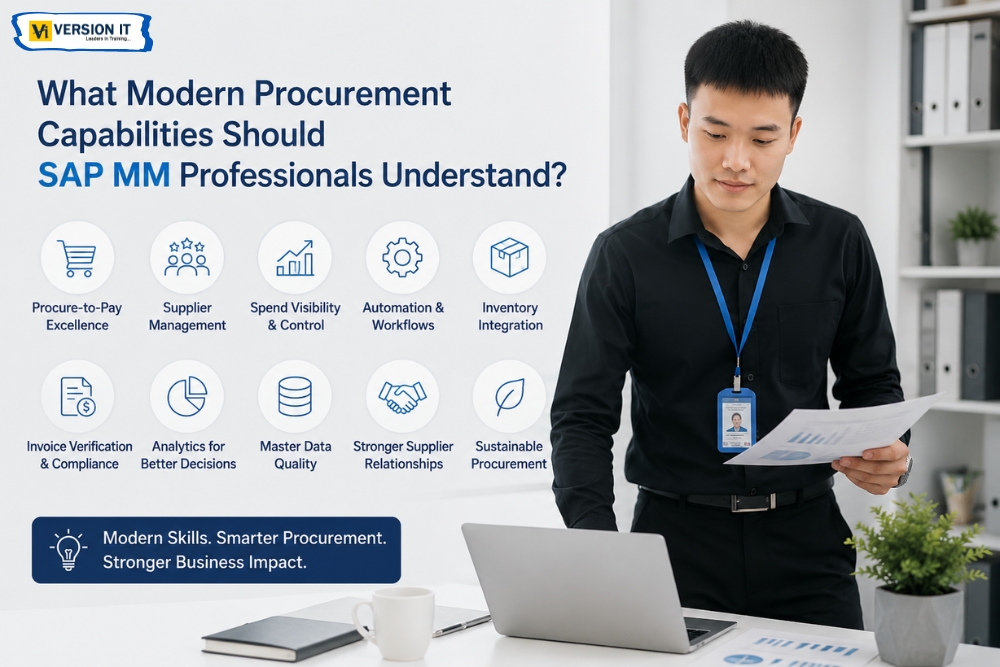
Modern procurement is becoming more connected, data-driven, automated, and focused on business outcomes. SAP MM professionals need to understand capabilities such as supplier management, procurement visibility, automation, spend analysis, inventory integration, invoice verification, analytics, and master data management.
These changes create opportunities for professionals who are willing to expand their traditional SAP MM knowledge. SAP MM Training in Bangalore can help learners establish the fundamentals, while a practical SAP MM Course in Bangalore can help them understand modern procurement scenarios. Choosing the right SAP MM Training Institute in Bangalore can further support learners in developing the practical and functional knowledge needed for today’s SAP procurement roles.